The Future of State Appliance Standards
In the first post of our state appliance standards blog series, we explored the history of state appliance standards in California and throughout the United States. Then, in the second installment, we summarized current state standards, identified the key components of a standard, and discussed opportunities for states to become more involved.
While plenty of opportunity remains for states to generate energy and cost savings from traditional appliance standards, the availability of new technologies and improved controls allows states to look to new opportunities for firm savings. In this third and final post in our series on state appliance standards, we will explore what the future of state appliance standards might look like and discuss what states can do now to prepare for that future.
Not How Much, but When: Opportunities for Flexible Demand Appliance Standards
Traditional appliance standards focus on reducing energy use for all 8,760 hours of the year. However, as more renewable generation comes online across state power grids, the lowest cost energy is no longer limited to the energy customers avoid using. It can also be the energy they use at specific times when clean power is abundant, such as during periods of strong solar production that creates excess supply.
Taking advantage of times of excess energy supply means shifting energy use to when the energy is cheapest and cleanest instead of when it is expensive and likely generated by older, gas or coal-fired facilities. New technologies in appliances like smart thermostats or water heaters enable them to shift their energy use in time with minimal or no effect on the consumer. However, accomplishing this requires (1) pricing that reflects the desired behavior (e.g., lower prices when energy is clean and plentiful) and (2) responsive appliances that can take advantage of that price signal.
In 2019, California adopted new legislation to support the development of flexible demand appliance standards. These standards require that appliances sold in the state be capable of responding to grid signals to help shift when energy is used. Flexible demand appliance standards in California consider multiple factors in their cost-effectiveness analysis not considered for traditional appliance standards, including the incremental cost of flexible capabilities, the value of greenhouse gas reductions, the operational cost savings, and the broader benefits to consumers from better aligning demand with the state’s energy supply. California established the first flexible demand appliance standard in 2023 with the regulation of pool controls to require that they contain a default schedule that takes advantage of the state’s plentiful solar energy. As of this writing, California is also in the process of creating flexible demand appliance standards for low-voltage thermostats, electric vehicle service equipment, and battery energy storage systems.
Similarly, Oregon and Washington have both passed legislation that, after their effective dates, require any electric storage water heater sold in the states to include a modular communications port compliant with CTA-2045-A, which enables water heaters to participate in programs like demand response. Effective dates were delayed in both states due to supply chain constraints, and the final effective date was January 1, 2023 in Washington, and July 1, 2023 in Oregon.
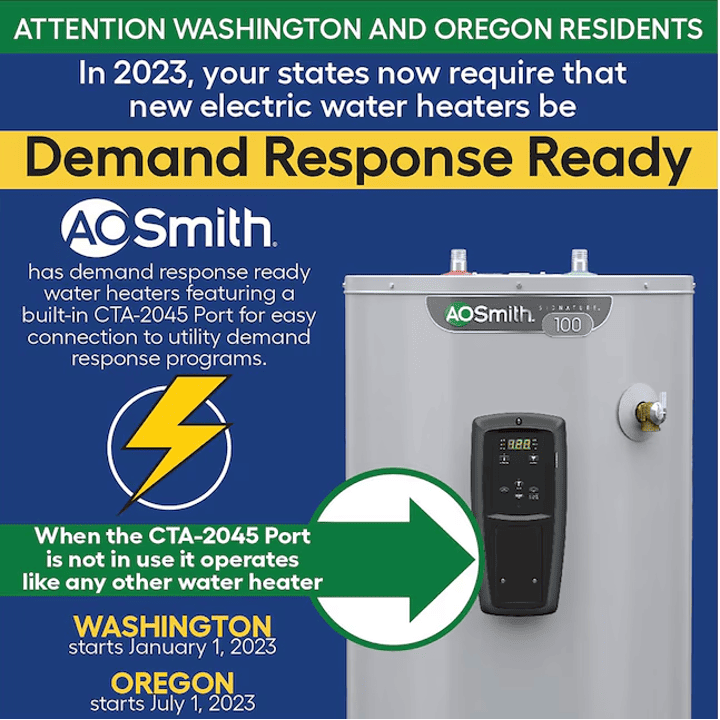
A CTA-2045 port on an electric resistance water heater. Image Source: A.O. Smith
It is tempting with flexible demand appliance standards to mandate a specific protocol or technology that an appliance must be sold with, such as a “smart” thermostat along with an HVAC system. However, just as with traditional appliance standards, the more that states can establish minimum performance criteria instead of prescriptive components, the more longevity the standard will have and the better equipped states will be to take advantage of new technologies. Following this principle will also reduce the cost of compliance and avoid barriers to future innovation. Establishing performance standards for flexible demand will likely require creating test procedures that can measure the appliance’s ability to respond to different signals effectively, such as AHRI Standard 1430 for electric storage water heaters. Industry associations such as AHRI and CTA have been working to develop consensus-based test procedures that achieve this goal, presenting an opportunity for states to work with these associations or use these test procedures as a basis for state-specific modifications.
Not Energy, but Greenhouse Gases: Regulating Appliance Emissions
While traditional appliance standards have focused on energy use, some states and local governments have recently advanced decarbonization efforts by looking toward emission-based standards for appliances. Many appliances can be powered by either fossil fuels or electricity; with developments in heat pump technologies, electric technologies are increasingly efficient, and many electric appliances are more efficient than their gas counterparts.
Under the authority provided in the federal Clean Air Act, air districts in California’s Bay Area and South Coast have considered or adopted zero-NOx appliance standards for certain water heaters and space-heating equipment (Bay Area AQMD, Regulation 9, Rule 4 and Rule 6; South Coast AQMD, Proposed Amendments to Rules 1111 and 1121, Rule 1146.2). These standards limit the sale or installation of equipment that cannot meet the prescribed emissions limits. Because these standards do not regulate energy use itself, they are not believed to be preempted by federal appliance standards. The California Air Resources Board is considering statewide standards regulating either the NOx or the greenhouse gas emissions of water-heating and space-heating appliances to support meeting its climate change goals. New York has also supported legislation to begin looking into opportunities for emissions-based appliance standards.
Emissions-based standards must be developed thoughtfully, with consideration given toward (1) the technological feasibility of replacing a fossil-fuel system with an electric one, (2) the incremental cost to the customer of switching from to an electric system, and (3) the change in utility bills in going from a fossil fuel system to an electric one (which will depend on the “spark gap”). Some applications for zero-emission appliances are already “no brainers” – they are technologically feasible, they have short payback periods, and customer utility bills will stay the same or be reduced.
For example, installing a heat pump water heater in a new single-family home in an area with a small or no spark gap is technologically feasible, cost-neutral or cost-saving to the consumer, and would improve local air quality by decreasing direct greenhouse gas emissions. In contrast, replacing a historic commercial building’s site-built gas boiler would require significant infrastructure costs that are unlikely to be recouped by the building’s owner. However, these economically infeasible applications are generally specific and limited, and should not be a barrier to a policy that broadly drives adoption of zero-emission appliances. Instead, policymakers should solicit substantial input on potential cost or technological barriers to implementation, create narrow exceptions as needed, and support voluntary programs to develop a market around zero-emission appliances that will innovate to further reduce cost and technological barriers.
Not Many Regulations, But One Regulation: Horizontal Appliance Standards
Appliance standards usually regulate a single appliance category in a vertical way, typically by setting a standard that addresses the appliance’s on-mode, standby-mode, and off-mode energy use. This strategy overlooks those appliances that use too little energy to regulate individually, but that collectively consume a significant amount of energy.
Recognizing this problem, the EU has adopted regulation that places a cap on standby mode energy consumption for all covered appliances. This new regulation is expected to save 4 TWh of electricity annually by 2030. Seeing this opportunity, California has opened a proceeding to consider how to limit energy use in low-power modes, with an intent to support voluntary industry commitments instead of mandatory reporting and enforcement. If adopted, this type of approach would be the first horizontal standard in the United States and has the potential to achieve 2,400 to 3,600 gigawatt-hours in energy savings per year. Recognizing the significant energy-saving opportunity, ENERGY STAR before 2025 had begun to consider opportunities to support horizontal low power mode limits as well.
Another low-profile, high-energy-use issue is power factor, which is the ratio of real power (kW) to apparent power (kVA) consumed by an appliance or a building. Although power factor is not something reflected in a volumetric utility rate, it can have dramatic impacts on the utility system, driving up the utility costs that are then indirectly passed on to customers. Establishing minimum power factor standards for all appliances already subject to regulation can yield significant savings to the utilities. However, because it does not fall into a traditional cost-effectiveness test, most states would need new legislation to establish a horizontal power factor standard.
Finally, states can consider regulating components that are used in many products instead of regulating each product itself. One example of this is the regulation of battery chargers, which began as a state effort in California and eventually became a federal appliance standard. Battery chargers, which are used in many different consumer and commercial products such as laptops, cell phones, and toothbrushes, all have similar technologies that can reduce energy waste both while charging and when the charger is plugged in without the battery attached. A related opportunity for states is to consider unregulated electric motors. Like battery chargers, electric motors are used in many commercial and consumer products, including HVAC equipment, clothes dryers, pumps, and fans. By regulating the motor itself, states may be able to achieve additional energy savings in these other products that are not captured under vertical standards.
Innovation as Opportunity
As we have described above, there are many potential opportunities to regulate appliances beyond traditional energy consumption limits to obtain cost and energy savings for customers. However, work still remains for traditional appliance standards. As long as manufacturers continue to innovate new technologies and controls, appliances will continue to become more energy efficient. And, as long as new products come out, there will be a need to ensure that these products use do not consume more energy than they need. Revisiting appliance standards periodically as technology evolves will continue to generate benefits from innovation by reducing energy consumption, reducing costs to consumers, and expanding markets for energy-efficient products.
As our world becomes increasingly connected, new types of regulations may be needed as well. ENERGY STAR has begun a proceeding to consider system-based standards for commercial heat pump water heaters, which are installed in multiple parts, not as a single product. Similarly, building performance standards provide an opportunity to decrease energy and greenhouse gas emissions by considering the entire building as a system. In some cases, replacing appliances will yield significant savings, while elsewhere, better managing the building systems already installed may be the best opportunity available. Colorado and New York City have been leading in this space, providing a roadmap for other states and local governments interested in driving system efficiency through building performance metrics.
If the past is any indicator of the future, then appliance standards will remain a key policy tool for states to achieve their energy and climate goals. The keys to successful implementation are to remain laser-focused on cost-effectiveness so that both appliances and utility bills are affordable to customers, to engineer performance-based standards instead of simple mandates to drive innovation and reduce implementation costs, and to look for opportunities to aggregate products or systems for greater impact.
At 2050 Partners, now as part of West Monroe, we are committed to helping our clients leverage energy efficiency standards, building energy codes, and innovative policy strategies to drive decarbonization and energy equity. To learn more about our work and how we can support your organization, please contact us today.